Starke Finance changelog
Changelog
The latest Starke Finance releases and improvements.
By continuing, you agree to our T&C and Privacy Policy.
Changelog September 2026
This month's work concentrated on two things: making the platform materially faster to use, and tightening the accuracy of the numbers we display across our funds.
Faster platform response times
Platform
We completed a significant database schema refactor across the platform. Views that previously took ten to twenty seconds to load — Portfolio, fund detail pages, and several admin surfaces — now return in under half a second in typical use. There is no change to what is displayed; the underlying data model was consolidated and the queries behind it were rewritten.
This is a foundational change and it unblocks several accuracy improvements described below, which depended on a cleaner data layer to be practical.
More reliable holdings and price data
Funds, FTaaS
Our on-chain indexer, which is responsible for keeping fund holdings, AUM, and NAV in sync with what happens on Solana, was rebuilt on a more maintainable foundation and now falls back to a polling loop if its live connection drops. In practice, this means fewer situations where a recent deposit or allocation change is slow to appear.
Alongside the indexer work, we identified and corrected a timestamp handling issue in our data pipeline where certain records were stored without timezone information. That discrepancy was quietly skewing a small number of holdings and AUM calculations; those calculations are now consistent.
We want to be direct about what is not yet resolved: in-fund swaps can still fail intermittently, and the per-fund Activity tab is temporarily unavailable while its query is being rebuilt. Both are tracked and will follow in a subsequent release.
Clearer NAV, AUM, and deposit figures
Funds
A rounding mismatch meant that NAV multiplied by the number of shares did not always equal the stated AUM — sometimes by a few cents, occasionally by more. NAV is now presented with enough precision that the two figures reconcile to within one US cent.
On the deposit screen, the minimum deposit is now labelled in the fund's actual deposit asset rather than a generic dollar sign. For the current rkShares funds this reads as USDC; for future funds that accept a different deposit token, it will display that token's symbol.
User experience
Platform, Funds
Removed the visible flicker that occurred each time the historic holdings chart refreshed its values, on both the Portfolio and Funds views.
Restored the Wormhole and dogwifhat ($WIF) token logos after their external image sources changed; both now load from a cached copy so they remain stable if the upstream URL moves again.
Fixes
Bug: Fund detail pages no longer get stuck on the loading screen when opened from the Funds list in the app.
Bug: The Holdings tab within a fund remains accessible immediately after a deposit. Note that the deposited balance itself can still take a short time to appear while indexing catches up — a separate improvement to that latency is in progress.
Bug: Corrected the timestamp/timezone handling behind several fund calculations, removing a class of small numerical discrepancies in holdings and AUM.
If anything here does not behave as described, or you would like more detail on a particular change, please reach out via our support portal.
Changelog August 2026
This month centers on the rollout of Portfolio v2, a set of stability fixes across FTaaS, and several refinements to the KYC flow. Alongside these, we shipped a number of smaller quality-of-life changes and bug fixes.
Portfolio v2
Platform, Portfolio
The new Portfolio experience is now live for all accounts. It presents a single view of everything held on Starke Finance: Fund positions, native and liquid staking positions, and wallet assets, aggregated across the platform wallet and any linked wallets.
The layout leads with total portfolio value and composition, and treats each position class consistently: value, returns, and (where applicable) rewards are surfaced on the same row pattern. For native staking, monthly native rewards are shown in the rewards row until fund-level redistributions become available in a later iteration.
The design brings the Portfolio in line with the rest of the platform visually and provides the structure we will build on for multiwallet views, richer per-position disclosure, and cross-chain staking positions later.
Fund holdings: balance and value columns
Funds, FTaaS
The holdings table on each fund page now includes two additional columns, Balance and Value, sitting alongside Price, 24h change, and Fund Allocation. This makes it possible to read a fund's underlying exposure directly, without needing to compute token quantities from allocation percentages.
Column widths have been evened out so the table reads cleanly on both narrower and wider viewports.
Transaction explorer
Platform
Links to on-chain transactions across the platform now open in Orb rather than the default Solana explorer. Orb's interface is oriented toward retail users rather than protocol developers, which we felt was a better fit for how our customers actually use these links to confirm a deposit, redemption, or stake action rather than to inspect program state.
KYC flow refinements
Platform, KYC
We made several changes to the identity verification flow based on feedback from customers going through it for the first time:
A Back button is now available on the verification screens where the provider permits it, so users can step backward through the flow without losing their progress up to the initial Individual/Entity selection. The provider's own close button has been disabled on those screens to avoid duplication with our own exit control at the top of the page.
The phone number step has been moved to a later point in the flow, after identity document capture. This ordering fits more naturally with how users move from establishing who they are to how we contact them.
On the Tax Information screen, a help control now links directly to the official IRS templates: Form W-8BEN and W-8BEN-E for non-US individuals and entities, and Form W-9 for US entities and businesses, so users can obtain the correct document without leaving the flow to search for it.
Copy on the Entity KYC screens has also been tightened for clarity.
Fixes
Bug: Deposits, redemptions, and asset swaps that were intermittently failing on funds now complete reliably. The underlying causes were an issue in the asset metadata indexer and a rate limit on our upstream price feed, both of which have been addressed.
Bug: Fund price charts now render deterministic 15-minute, 1-hour, and 1-day buckets, so the same chart viewed at different points within an hour shows the same bars. Previously, bucket boundaries shifted with the current minute, which made short-term charts appear to change shape between refreshes.
Bug: Native staking positions in the Portfolio now display the correct balance. Values that previously flickered between different figures on refresh have been resolved.
Bug: The Dashboard occasionally failed to load due to an intermittent query failure on the FTaaS API. Reliability on the affected endpoints has been improved; we are continuing to monitor and will patch any additional endpoints that surface the same behavior.
Bug: Fund holdings that were taking several minutes to reflect a manager's swap now update substantially faster following an indexing improvement.
Bug: The Max button on fund deposit inputs now reflects the actual balance in the user's wallet rather than the vault's configured maximum. When a wallet balance exceeds a vault cap, the existing warning at the bottom of the deposit screen continues to explain the limit.
Bug: Attempting to stake below the network minimum now shows a clear, up-to-date error message. The minimum is checked against the network dynamically, rather than against a fixed value, so the message stays accurate as network parameters change.
Bug: The Merge action in the staking service is now disabled when there are no additional stake accounts to merge into, removing a dead-end state that produced no useful action.
Bug: A rare condition that prevented ETFs from loading on the Explore page has been fixed.
Bug: A certificate issue on www.starke.finance that briefly caused a browser warning has been resolved.
If you have questions about anything above, please reach out to support.
Changelog July 2026
This month we opened Starke Finance to a wider audience through the Public Beta and used the run-up to that launch to sharpen the fund experience, the verification flow, and the platform's day-to-day polish.
Public Beta is open
Platform, Funds, FTaaS, rkShares
On July 8th we opened the Public Beta of Starke Finance to any investor who wants to try tokenized managed funds on Solana. The beta includes the first rkShares strategies running on FTaaS, alongside the existing Solana staking product, so new users can move from onboarding through KYC into a real position without waiting for a private invitation.
The beta environment runs its own set of funds with conservative deposit limits while we gather feedback and continue hardening the platform. Full context on what is available and who it is for is covered in our public beta announcement.
Multisig governance for the vault programs
Funds, FTaaS
The upgrade authority for the Solana programs that power our vaults, in both production and staging, has been transferred to a Squads-based multisig. Any future change to the on-chain program logic now requires multiple independent signers to approve it, removing single-key upgrade paths from the deployed contracts.
This is a foundational step for the fund tokenization engine: it aligns the operational posture of FTaaS with what customers should expect from a regulated asset manager, and it is a prerequisite for the further governance controls we plan to layer on top, such as timelocks and thresholds tuned per environment.
Referral program
Platform
We launched the first version of the Starke Finance referral program. Verified users now have a dedicated page from which they can share a personal referral link, and a follow-up email is sent seven days after a user completes verification to invite them to bring peers on-board once they have had time to explore the product.
The program is designed so we can adjust or pause incentives per phase without breaking existing links, which we expect to use as the product moves from beta into general availability.
Identity verification: broader documents, clearer flow
KYC, Platform
We reworked the identity verification experience around real customer feedback. Non-US applicants can now submit a National ID card in addition to a passport, and the Driving License option is only offered to US applicants, where it is a valid form of ID. Both routes remain automatically validated.
On the surrounding UI, the KYC progress bar now reflects the actual stage a user has reached rather than an inflated default, and the “Verify your identity” banner is removed once a user is verified. Verification status is also surfaced directly on the user avatar, with a colored indicator (green for verified, gold for accredited) and a hover tooltip that explains the current tier.
Fund page refinements
Funds, rkShares
Several changes on the fund pages bring the presentation closer to standard asset-management conventions. The chart previously labelled “Share Price” is now labelled “NAV,” which is the metric it actually shows, and the per-token qualifier next to NAV has been removed to match how tokenized funds are reported elsewhere in the industry.
On the same pages, the holdings stacked bar chart has been realigned so its axis dates match the bars and its percentages match the donut chart and the holdings table. The 30-day performance chart no longer shows uneven jumps between dates, terminology across the Depositors and Activity tabs has been standardized on “depositors,” and the redeem action is now disabled when only in-kind redemption is possible, so investors deliberately choose that path rather than fall into it. When the on-chain price feed is momentarily unavailable, the deposit and redeem panels now display a clear waiting state instead of appearing blank.
Portfolio and Dashboard consistency
Platform
Dashboard total return and the Portfolio return figures are now sourced from the same endpoint and therefore report the same value. Very small numerical residues that used to show up as a stray “−0.05” in one view and “0” in another are handled consistently.
Separately, we identified and backfilled a gap in historical rkSOL pricing that could cause the Portfolio page to time out for wallets with earlier liquid-staking activity. Those wallets now load reliably.
User experience
Platform, Funds, KYC
The wallet menu now expands from anywhere on the button, not only the small arrow.
Small spacing added between adjacent action buttons on mobile.
First and last names now render in title case rather than uppercase.
The Deposit shortcut on Explore listings has been removed; deposits are initiated from the fund page itself, where verification checks live.
The 2Z asset icon now displays consistently across every view where the asset appears.
X sign-in has been temporarily removed while we evaluate it for a future update.
Fixes
Bug: Portfolio no longer times out for wallets with earlier rkSOL activity; the missing historical price data has been backfilled.
Bug: Dashboard total return and Portfolio returns now agree because both read from the same endpoint.
Bug: Deposit and Redeem panels render a clear waiting state when the on-chain price feed is momentarily unavailable, rather than showing an empty section.
Bug: Fund creation no longer fails partway through setup in FTaaS.
Bug: The NAV chart on fund pages is correctly labelled NAV instead of Share Price.
Bug: The holdings stacked bar chart axis is now aligned with its bars, and its percentages match the donut chart and holdings table.
Bug: The 30-day fund chart no longer shows uneven jumps in its date axis.
Bug: Corrected the “Fundementals” typo on the fund page to “Fundamentals.”
Bug: Explore now loads all pages of results, including the later pages that previously appeared empty.
Bug: Re-ordering assets on Explore no longer clears the active category filter.
Bug: The sidebar no longer intermittently collapses when navigating to Funds.
Bug: The Portfolio card is now clickable across its full area, not only over the small arrows.
Bug: The Phantom wallet warning previously shown against our staking tokens has been removed after Phantom whitelisted them; a residual notice tied to Token-2022 extensions may still appear and is expected.
Bug: Signing out no longer triggers an unnecessary transaction signature prompt. Some follow-on wallet prompts are governed by the connected wallet itself and cannot be suppressed on our side.
As always, questions and feedback are welcome at support.starke.finance/request.
Starke Finance Opens Public Beta: Tokenized Managed Funds on Solana

Starke Finance Launches Public Beta: Tokenized Managed Funds, Built on Solana
San Francisco, CA, July 8th, 2026. Starke Finance, a California-registered investment platform with fund management operations in Delaware, today announces the launch of its public beta. Starting today, the first 100 registered participants will gain access to live, Solana-native tokenized managed funds, marking a significant milestone in the company's mission to bridge traditional portfolio management with decentralized finance.
About Starke Finance
Starke Finance is a digital asset investment platform designed to make managed fund investing accessible, transparent, and composable. The platform enables investors to gain exposure to a curated range of digital assets through actively managed, tokenized funds, while giving portfolio managers the infrastructure to build, launch, and distribute their own strategies.
At its core, Starke Finance uses Solana-based programs to automatically acquire the underlying assets that compose each fund, minting a corresponding number of fund tokens that accurately represent the underlying portfolio's value and behavior in real time. The result is a self-custodied, fully transparent investment vehicle that settles near-instantly and operates without the friction of traditional fund structures.
The platform serves three distinct profiles: investors seeking managed exposure to digital assets, fund managers looking to tokenize and distribute their strategies, and Solana stakers who want institutional-grade yield infrastructure. Starke's operations are ISO 27001 and SOC 2 certified, and the platform undergoes independent third-party audits, with reports published publicly on the company's trust center.
Why Solana
The choice of Solana as the foundation for Starke Finance is deliberate and deeply considered. Solana's architecture provides the combination of throughput, cost-efficiency, and composability that tokenized fund management demands at scale.
With sub-second finality and transaction fees that remain fractions of a cent even under heavy network load, Solana eliminates the cost and latency barriers that have historically made on-chain fund mechanics impractical. For a platform where fund tokens must be minted, rebalanced, and redeemed continuously, this matters enormously.
Beyond raw performance, Solana's ecosystem offers unmatched depth for a product like Starke Finance. The network hosts a mature DeFi landscape, including Jupiter for liquidity aggregation, Jito for validator infrastructure, and Sanctum for liquid staking primitives, all of which Starke actively integrates with or plans to build upon. As the tokenized Real-World Asset (RWA) space grows, Solana has also emerged as one of the leading networks for bringing regulated, off-chain assets on-chain, making it the natural home for Starke's long-term roadmap.
Starke Finance runs its own Solana validator, further anchoring the company's commitment to the network and contributing directly to its security and decentralization.
Public Beta: Scope and Structure
The public beta opens todayt, July 8th, 2026, and is structured to validate the platform under real market conditions in a tightly controlled environment.
Participation is limited to the first 100 registered users. Deposits are capped to a maximum of 10 USDC, ensuring that the testing window remains accessible and low-risk while generating meaningful signal on product behavior, fund mechanics, and user experience.
The beta includes live testing funds operating with real capital. These are not simulations. Participants will interact with the actual Starke Finance protocol, acquiring tokenized fund positions, observing real-time performance, and engaging directly with the infrastructure that will underpin the production release.
Testing is expected to run for approximately two months, though the timeline will flex based on findings. When the team is confident in the platform's stability, behavior under load, and readiness, the production release will follow.
Feedback from beta participants is a core input to this process. Issues, observations, and requests can be submitted directly through the support portal at support.starke.finance.
Production Launch and rkShares Blue Chip
Following the beta period, Starke Finance plans to move to full production on Q4 2026. The production launch will include the debut of rkShares Blue Chip as the platform's first regulated fund, a significant step in Starke's strategy to offer institutional-quality investment products on-chain.
The public beta environment will remain available after the production launch and will continue to operate until further notice, allowing new users to explore the platform in a sandboxed, low-stakes context before committing to live production positions.
Product Roadmap
Starke Finance's development is organized around four strategic streams. Each reflects a distinct dimension of the platform's evolution, from near-term user experience improvements to long-horizon infrastructure that could reshape how funds are created and distributed globally.
Stream 1: User-centric platform development
The platform's most immediate focus is on reducing friction for both crypto-native users and those coming from traditional finance. The gap between how DeFi products currently work and how mainstream financial users expect them to work is still significant, and closing that gap is central to Starke's near-term roadmap.
Upcoming developments in this stream include gasless transactions, eliminating the need for users to manage SOL for fees; on-ramp and off-ramp integrations, enabling direct fiat-to-fund flows without requiring users to navigate external exchanges; enhanced charting and analytics, giving investors the same visual clarity they expect from traditional asset management platforms; and a dedicated portfolio section, consolidating fund positions, performance history, and staking rewards into a unified view.
These improvements are designed to make the platform feel native to both audiences: powerful enough for DeFi-native users who understand the underlying mechanics, and intuitive enough for traditional investors who simply want transparent exposure to managed digital asset strategies.
Stream 2: Asset quality and variety
Starke Finance's value proposition scales directly with the quality and breadth of assets available within its funds. The second stream is focused on continuously raising the bar on both dimensions.
In the near term, this means deepening coverage of high-quality Solana-native assets: established tokens with strong liquidity profiles, credible fundamentals, and clear utility within the ecosystem. As the Solana-based RWA space matures, Starke will actively monitor and evaluate emerging tokenized real-world assets for inclusion, spanning equities, bonds, commodities, and other institutional-grade instruments.
The goal is not to maximize the number of assets on the platform, but to ensure that every asset included meets a rigorous standard for quality, liquidity, and regulatory clarity. This careful approach to asset selection is what enables Starke to operate at the intersection of DeFi accessibility and institutional-grade reliability.
Stream 3: DeFi integration and yield generation
Tokenized fund shares are not just investment vehicles. They are on-chain assets with the full composability that implies. The third roadmap stream is focused on unlocking the yield potential that tokenization enables.
Starke plans to integrate its funds with DeFi protocols, allowing fund tokens to participate in lending markets, liquidity pools, and other yield-generating mechanisms without requiring investors to exit their fund positions. Beyond the fund level, the platform will also explore DeFi integrations at the holdings level, enabling the individual assets within a fund to generate yield through vetted protocol integrations, with the proceeds flowing back to fund token holders.
This approach expands each Starke fund beyond a static basket of assets into an actively managed position that draws on the full breadth of what Solana's DeFi ecosystem has to offer.
Stream 4: Fund Tokenization-as-a-Service (FTaaS)
The most expansive stream on Starke's roadmap is the evolution of its Fund Tokenization-as-a-Service offering, a platform that enables external fund managers to launch, manage, and distribute their own tokenized funds using Starke's infrastructure, either through a white-label interface or directly via API.
FTaaS is already live in early form, but the roadmap here is ambitious. In the near term, Starke will continue expanding the capabilities available to fund managers: compliance tooling, performance analytics, distribution mechanics, and portfolio construction primitives. A key priority is extending FTaaS to support regulated assets, enabling managers operating in traditional finance to bring compliant, institutional-grade products on-chain without having to build the underlying infrastructure themselves.
Looking further ahead, Starke's vision is for FTaaS to evolve into a transfer agent layer for tokenized RWAs on Solana, handling the issuance, recordkeeping, and lifecycle management of tokenized securities in a way that meets regulatory expectations while operating entirely on-chain. This capability builds naturally on what Starke has been doing from the outset: natively aggregating and managing on-chain assets within structured fund vehicles. The convergence of both capabilities means that a tokenized security can be originated, managed through its full lifecycle, and made available within a governed fund structure, all within the same platform. This would position Starke not just as a consumer investment platform, but as critical infrastructure for the broader tokenization of real-world finance on Solana.
Participate in the Beta
Spots in the public beta are limited to the first 100 registrations. Participants will engage directly with the protocol, contribute feedback that shapes the platform's development, and gain early access to Starke Finance ahead of the full production release.
To register and for all inquiries, visit support.starke.finance.

About Starke Finance
Starke Finance is a digital asset investment platform built on Solana, enabling investors to access tokenized managed funds and giving portfolio managers the infrastructure to build and distribute their own strategies. The company is registered in California with fund management operations in Delaware, and is registered with and regulated by the SEC. Starke Finance operates its own Solana validator and offers a suite of services including liquid staking (rkSOL), Fund Tokenization-as-a-Service, and institutional custodian integrations. Operations are ISO 27001 and SOC 2 certified.
Website: starke.finance
App: app.starke.finance
Support: support.starke.finance
Documentation: docs.starke.finance
This announcement does not constitute investment advice. Participation in the Starke Finance public beta is subject to applicable terms and conditions. All investments carry risk.
Changelog Update - Week 4
We continue our journey after a month of public progress in our open development phase. Below, you will be able to see the most remarkable updates from last week.
If you would like to know more or have any further questions, feel free to reach out at [email protected] and if you would like to request any additional feature to our roadmap, share your feedback here.
Public beta preparation
We're continuing to prepare our public beta and have implemented a toggle between Production and Beta environments, allowing users to test new platform features.
The public beta environment will be connected to Solana mainnet, meaning deposits will use real assets. However, we've set a maximum limit of 10 USDC per user, allowing participants to acquire and redeem test fund shares while sharing feedback with us. This approach will help mature the platform, build early user traction, and generate valuable feedback for continuous improvement. The estimated launch of the beta environment will be this first half of 2026.
Important: Assets in the beta environment are not regulated managed funds.
Granular Transferability Controls
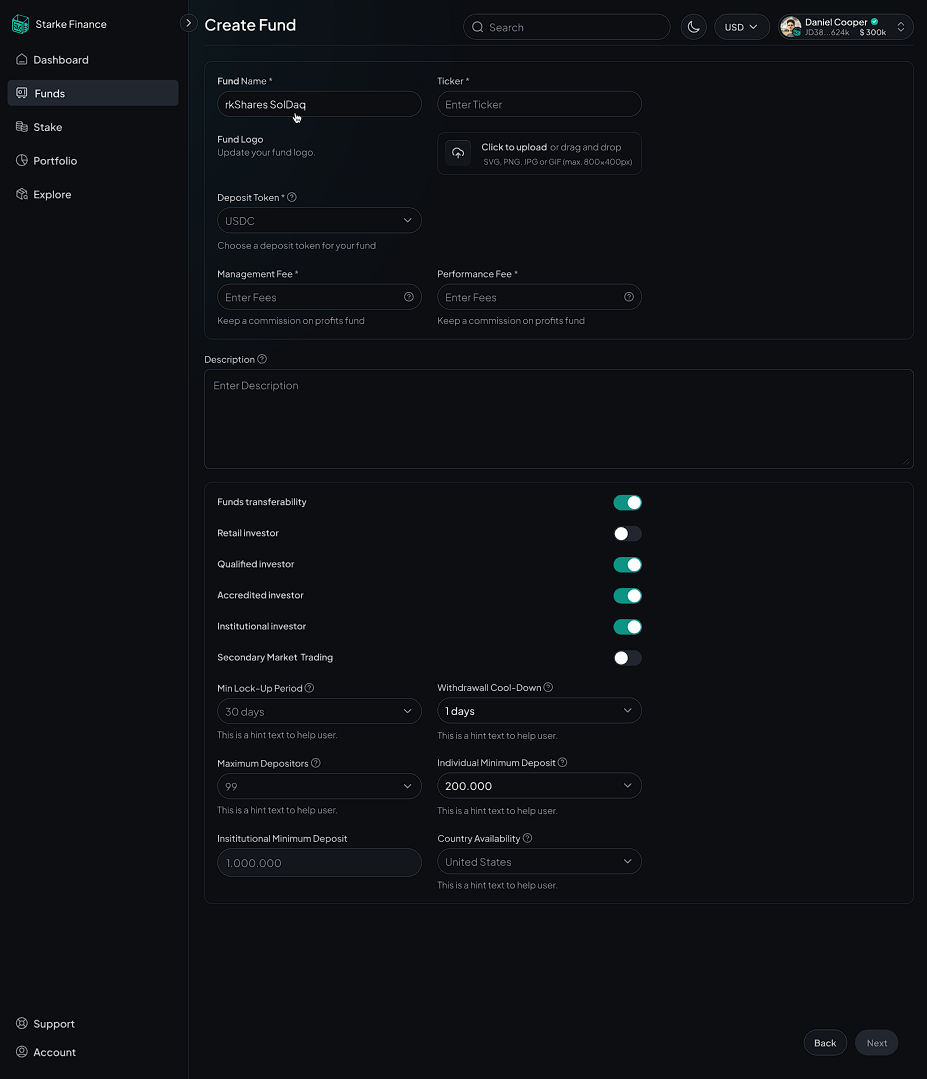
In our Solana program we have implemented transfer hooks leveraging Token 2022, however current implementation that will be delivered in our first release only allows fund shares transferability enabled or disabled, without additional granularity. As part of US regulation and dependent on the tokenized security type, a fund managed could enable transferability to specific personas, like KYCd investors or accredited investors. On this phase we have completed the first phase of this implementation that is expected to land in Version 1 of our platform, expected to be shipped on the second half of the year.
Fixes
Bug: Remove duplicated metadata on the landing page so search engines index pages correctly and social previews render as expected
Bug: Funds → Activity links to Transactions now point to Mainnet instead of Devnet
Bug: Portfolio → My transactions renders reliably so you can review history without UI errors
Bug: An issue when redeeming fund shares have been solved and balances update as expected.
Bug: A sandpit fund was not loading after having intereacted with it. Now the fund page loads consistently.
Bug: Multiple various minor fixes across frontend to adapt to multiple devices and resolutions.
Changelog Update - Week 3
We continue our journey after three weeks of public progress in our open development phase. Below, you will be able to see the most remarkable updates from last week.
If you would like to know more or have any further questions, feel free to reach out at [email protected] and if you would like to request any additional feature to our roadmap, share your feedback here.
Deposit and Redeem Flow Improvements
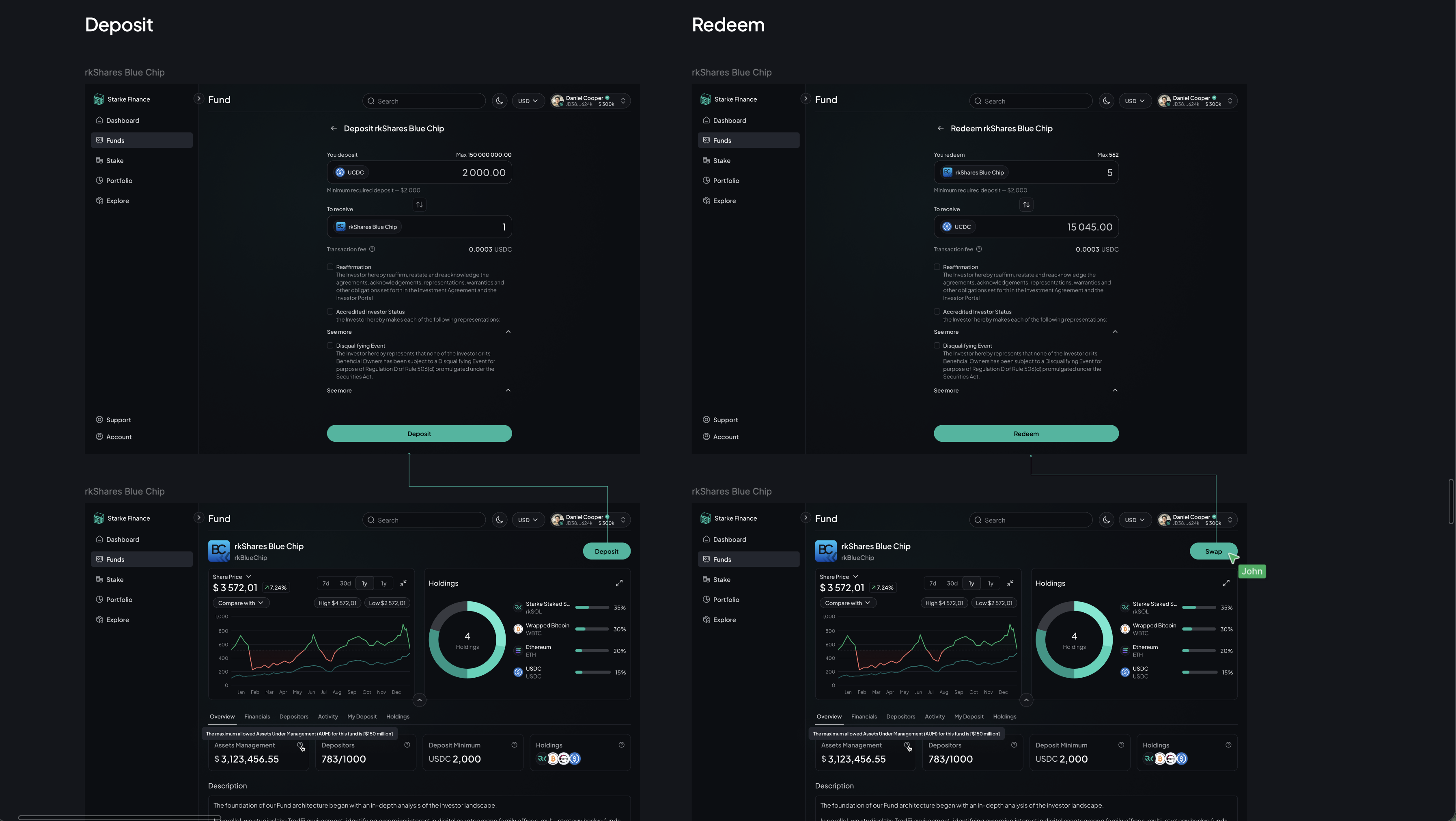
You get a clearer flow for depositing and redeeming funds. The new design and implementation in our sandpit environment use a more traditional, public-oriented approach. This new approach is intended to minimize user interactions while at the same time showing all the required information, such as a simulation of shares obtained when depositing and the self-survey to meet the eligibility criteria defined by the SEC.
KYC/KYB implementation with Persona
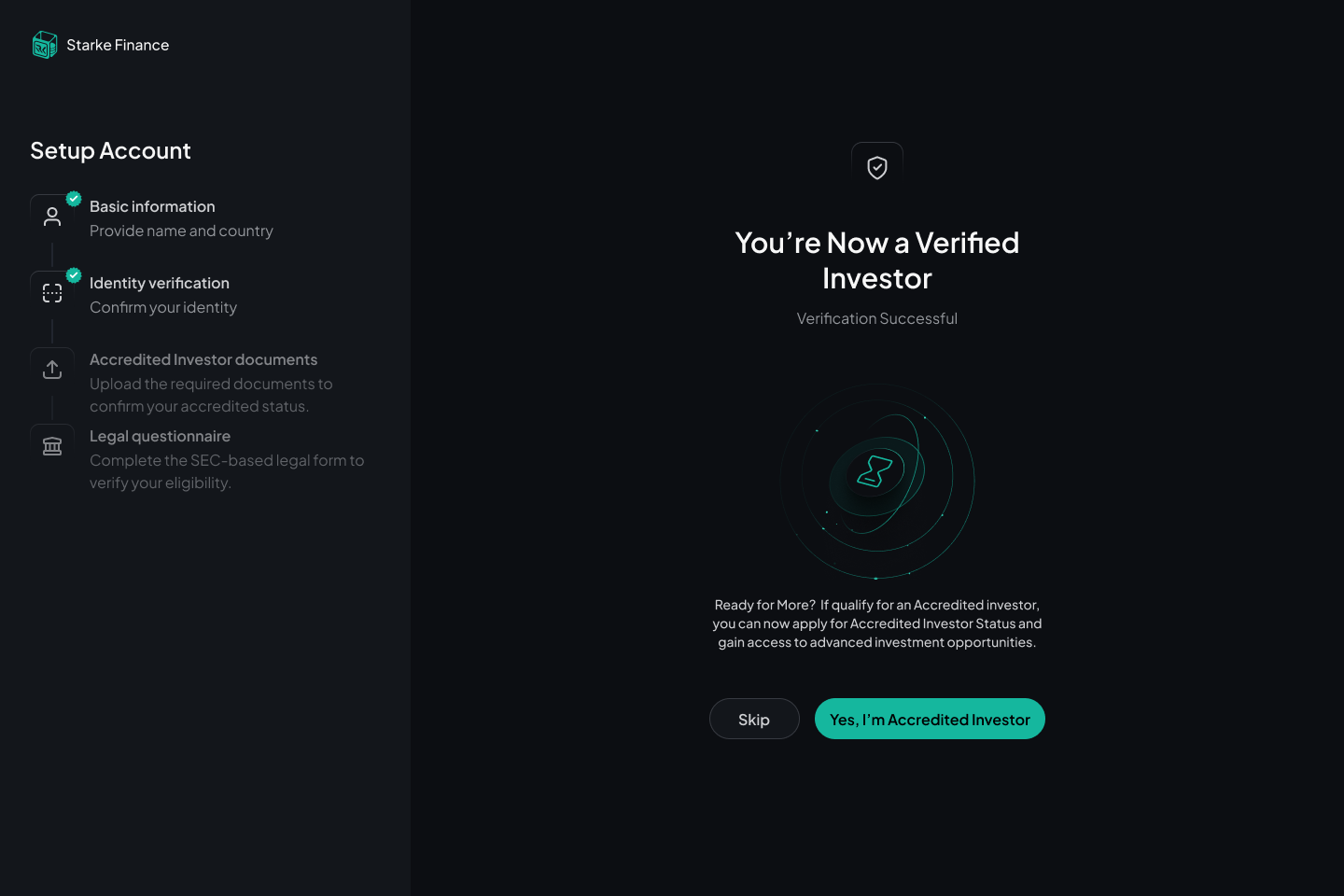
This past week, we have progressed in our sandpit environment to deploy our end-to-end workflow for KYC/KYB and accredited investor verification with our provider, Persona. This integration, required by the SEC in order to offer our tokenized managed funds, will enable us to comply with regulations while also providing a smooth and quick onboarding experience, with automated workflows and document verification enabled by AI-based capabilities.
This is just an example on how one of our screens will looks like:
Two-Factor Transaction Signing
You can require a second factor authentication when you sign transactions such as adding Passkeys or one time password. This reduces the risk of unauthorized signing and protects you from account takeover and malware-triggered approvals.
Turn it on/off in Account → Security
Below you can also check a list of minor improvements and bug fixes we have solved over the week.
Improvements
Backend: Add start_time and end_time query param filters to /vaults/investments so you can pull period-specific information.
Backend: Generated timestamps now use the last safe/known value to avoid gaps in charts and exports when upstream data is delayed
Backend: Include icon in fund assets in FTaaS endpoint so UIs can display branded asset visuals without extra lookups
Product Design: We have completed the new designs for the expansion of our staking service to other blockchain networks. This includes new branding assets, new landing page and the addition of a multichain concept in our staking service front end.
Online shop: We have completed the new page design for the creation of an online shop featuring Starke Finance merchandise. To be enabled after the release of the public beta (H2 2026)
Fixes
Bug: API endpoint that simulates shares to be received now returns accurate values after fees and rounding
Bug: Fixed get starke config endpoint to reliably return the correct configuration payload across environments
Bug: Historic asset holdings synchronization resumes correctly so portfolio charts and totals reflect the full backfill
Changelog Update - Week 2
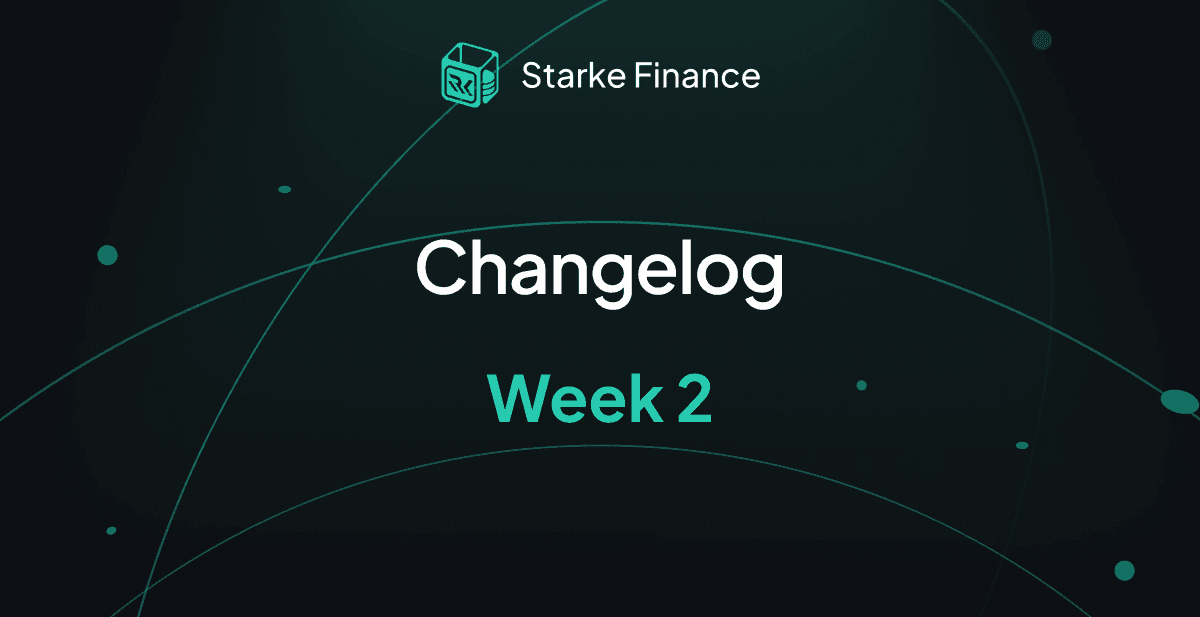
Historic Fund Holdings
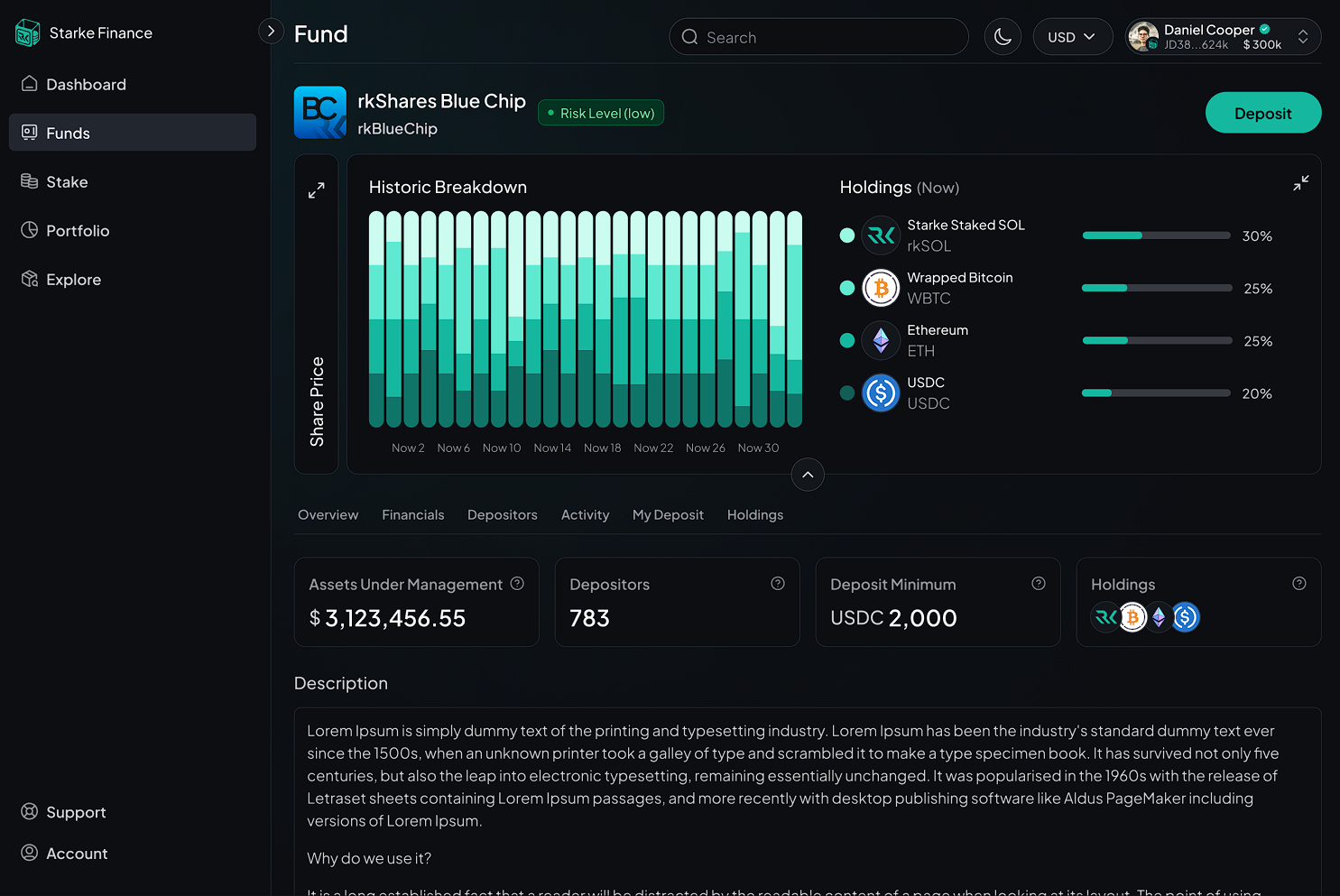
View historic fund holdings has been implemented in our sandpit environment. So you can track portfolio composition over time and explain performance to stakeholders. See position weights and quantities at any past date, compare changes across periods, and understand how inflows, outflows, and market moves affect each Fund. This brings transparency on the portfolio management strategy taken and helps you answer questions about exposure and risk with confidence.
Check the below design screenshot as demonstration of how the end feature will looks like.
FTaaS API documentation in GitBook
Remember that FTaaS is a service that can be consumed in two ways.
As a Fund Manager, you can create a Fund Manager account on our platform to manage your own Managed Funds. In parallel, FTaaS also provides an API, allowing third-party asset managers to consume our IT backend stack, including the data indexer and blockchain logic through our internally developed and now open sourced Solana program.
This API is designed to reduce friction when adopting blockchain-based products within your organization. Browse our API documentation on GitBook, and feel free to contact us with any questions or feedback.
Open-source Starke Vaults Program
You can now access the Starke Vaults Solana program as open source in GitHub. Use the same on-chain contracts we run in production to create, manage, and settle tokenized vaults on Solana. This gives you transparency, contributes to the Solana ecosystem and makes it easier to meet compliance and security reviews across your organization.
Remember that our Solana program is intended to cover most of the global use cases to manage multi asset vaults in compliance with the SEC requirements. You will find out, transferability restrictions, token and user whitelistings methods, maximum and minumim deposits etc. Also the first version was already audited by our partner security firm Kudelski Security (Starke Finance Trust Center), however we are planning new changes for additional features.
Improvements
Backend: POST /vaults endpoint moved from legacy SDK to new FTaaS API endpoint.
Fixes
Bug: Stabilized API under load to eliminate CPU spikes and crash loops, so requests complete reliably during traffic surges
Bug: Redeem now returns the correct deposit token to the investor when fund tokens are burned, restoring a complete redemption flow.
Bug: Sorting on the vault investors endpoint applies correctly, returning results in the requested order.
Pre-release - Open development phase
New Landing Page
Explore a refreshed landing experience that presents our style and a presentation of our upcoming Managed Funds, what will be the core of our Products.
In the new Landing page you will also get clear pathways to staking, fund overviews, ecosystem and documentation, supported by fast load times and accessible design across devices. The page reflects institutional standards while welcoming crypto-native users.
Visit starke.finance to see it in action.
Starke Staking Service
Stake natively or via liquid staking into the Starke Finance Validator with intuitive user experience and transparency including estimated yields, network costs and current market condition. Connect your wallet or chose our embedded Starke Wallet (powered by Dynamic), choose stake type and track positions from a unified view. The flow is non-custodial and designed to keep you informed at each step.
You earn yield while keeping flexibility that matches your strategy.
Dashboard
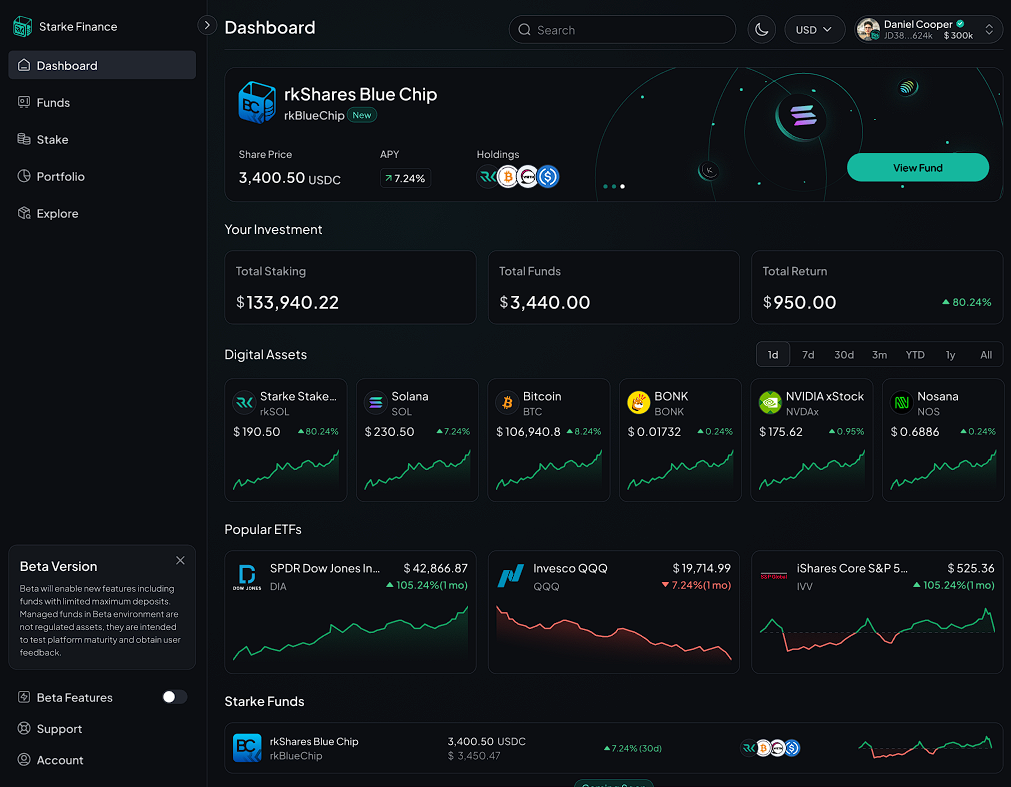
We have introduced a preliminary version of the main dashboard of our platform. It includes several sections, such as a summarized view of your portfolio—later expandable into a more detailed and comprehensive view—as well as the performance of individual assets, ETFs, and Starke Funds.
You’ll also find a quick overview that can be skipped at any time by using the intuitive left-hand menu we’ve prepared for you. From there, you’ll be able to navigate across all platform sections, including those that are still under development.
Production Improvements
Authentication: User accounts experience with embedded wallets to simplify sign-in and reduce context switching
FrontEnd: Multiple wallet syncing for whitelist to simplify compliance for multi-wallet users
Frontend: Migrate market data display from Jupiter to Birdeye for fresher prices
Frontend: Show network and protocol costs before confirming native or liquid staking.
Frontend: Embedded wallet migration to Dynamic v3.
Production Fixes
Frontend: Sidebar polishing for clearer icons, spacing, and states
Development progress
Authentication: User flow design and deployment in sandpit environment of the KYC and KYB required to streamline compliant onboarding.
Backend: Whitelist API endpoints for admin actions so approved staff can manage tokens, users, and managers securely
Backend: Include token info across deposit, swap, Jupiter swap-to-deposit, and withdraw operations for clearer confirmations
Backend: Close Fund capability to stop new deposits while keeping redemptions and reporting available
Backend: Vaults endpoint adjustments to align with updated portfolio and pricing models
Backend: Index liquid transactions for faster queries and accurate position histories
Backend: Max deposit limits per fund to control inflows
Backend: Refactor
GET /v1/api/vaults/vtoken_pricesfor accuracy and lower latencyBackend: Refactor
POST /v1/api/vaults/{vault_id}/vtoken_price/historyfor clean, consistent chartsBackend: Vtoken number of holders over time for investor growth signals
Backend: Fund inflows/outflows over time to monitor momentum
Backend: Fund AUM over time for trend analysis
Backend: Vtoken supply over time to understand dilution and growth
Backend: Vaults API estimate shares endpoint so you can preview expected shares before depositing
Backend: Vaults Admin GET & DELETE for whitelisted tokens, users, and managers to keep lists current
Backend: Vaults
API GET deposit/redeemtransaction fee to see estimated costs before submittingBackend: GET portfolio holdings diversity overtime endpoint to visualize historic fund holdings managementrisk
Backend: Vaults Admin GET Starke Config for transparent environment and parameter checks
Backend: Refactor
GET /v1/api/vaults/{vault_id}/assetsfor consistency and paginationBackend: Refactor
POST /v1/api/vaults/{vault_id}/investors/count_historyfor reliable investor chartsBackend: Refactor
GET /v1/api/vaults/{vault_id}for a unified detail responseBackend: Refactor
POST /v1/api/vaults/{vault_id}/assets/historyto improve data fidelityBackend: Deposit transactions for Funds in sandpit environment complete reliably without intermittent failures
Backend:
GET /whitelisted-users and /whitelisted-managersendpoints return correct resultsBackend:
POST /whitelist-token and /remove-whitelisted-tokenoperate as expectedBackend: Vaults Admin
POST Pause/ResumeStarke endpoints function correctlyBackend: Refactor
POST /v1/api/vaults/{vault_id}/vtoken_volatility/historyfor consistent volatility historiesBackend: Refactor
POST /v1/api/vaults/{vault_id}/metadatato standardize fund metadata updatesBackend: Refactor
GET /v1/api/vaults/{vault_id}/transactionswith filters and performance improvementsFrontend: Creation of admin panel to unify common operational tasks such as dashboard visualization, token whitelisting and visualization in Explore section.
Marketing: Gift box preparation for partners and investors.
Design: New landing page for users designed in Figma to improve conversion coming from ads
Design: Dedicated rkPool fund page designed in Figma